Why the Ground Deserves Early Attention
A building can look sound above grade while the ground below it is changing. Settlement, slab cracking, water intrusion, uneven floors, and excavation instability may begin with soil movement, weak fill, or groundwater pressure rather than an obvious structural defect. Surface observations are useful, but they rarely tell the whole story beneath the foundation. When evaluating options such as permeation grouting Texas, project teams should begin with the site conditions and performance goals, not with a preferred technique. Pier-A-Mid Inc., a Houston-based contractor serving Texas, presents its subsurface and jet grouting work as a resource for soil treatment, hydraulic control, structural rehabilitation, and work around active facilities. Its experience with grouting applications in Houston and across Texas makes the company relevant when a project requires a closer look at in-place ground treatment options. The central question is simple: what must change on the ground? A project may need to reduce settlement, strengthen loose material, control seepage, support an excavation, fill voids, or improve load transfer. Once the objective is clear, the design team can compare methods based on evidence rather than assuming a single solution works everywhere.
Texas Has More Than One Soil Story
Texas includes expansive clay, coastal deposits, loose sand, gravel, uncontrolled fill, fractured rock, limestone, shale, and mixed alluvial soils. Soil profiles are shaped by parent material, climate, slope, water, and time. The Texas Department of Transportation provides a useful overview of Texas soil and bedrock conditions, including the way soils are identified by grain size, density or consistency, and moisture content.
- Clay: Some clay soils change volume as moisture levels rise and fall, which can affect shallow foundations and slabs.
- Sand and silt: Loose or saturated granular soils may shift, settle, or lose support during excavation and water movement.
- Fill: Previously placed material can be inconsistent, particularly when its placement and compaction history are unknown.
- Rock: Rock may improve bearing conditions, but fractures, weathered zones, voids, and drilling limits can complicate design.
- Groundwater: Shallow or changing water levels can influence seepage, soil strength, excavation stability, and drainage planning.
Start With a Site Investigation
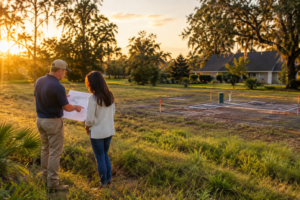
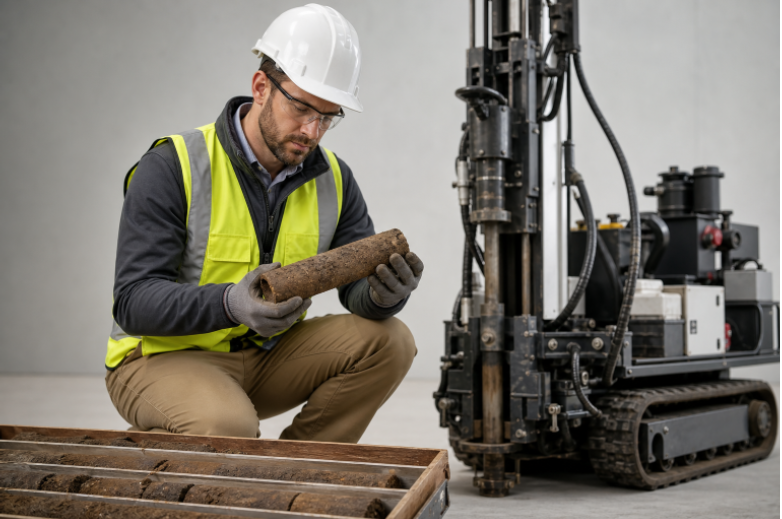
Ground improvement should follow a reliable subsurface investigation. Borings, test pits, sampling, laboratory testing, groundwater observations, utility records, drainage history, and prior construction information can help define the actual soil profile. Conditions can vary within a single parcel, so a single boring should not automatically be treated as representative of the entire building footprint.
A practical investigation process includes the following steps:
- Review available geologic, construction, drainage, and repair records.
- Perform borings or other appropriate field exploration.
- Classify soils and test samples where design decisions require it.
- Identify groundwater levels, seepage paths, weak zones, fill limits, or possible voids.
- Set measurable goals for bearing support, settlement, strength, stability, or water control.
Match the Method to the Problem
Ground improvement is a category, not a single product. Federal guidance on ground improvement methods discusses techniques such as grouting, stone columns, vibro compaction, dynamic compaction, deep soil mixing, and reinforced soil systems. The appropriate choice depends on soil type, treatment depth, groundwater, structural loads, construction access, and the needed level of verification.
Common Options and Their Uses
- Permeation grouting: Low-viscosity grout may be injected into connected pore spaces or fractures where the ground is suitable for grout travel. It can be considered for reducing seepage, improving granular soil, or targeted void treatment.
- Compaction methods: These densify loose granular material and reduce void space, but they may not suit vibration-sensitive sites.
- Jet grouting: This method breaks up and blends soil with grout to form treated columns or masses, often where targeted in-place treatment is needed.
- Deep soil mixing: Soil is mechanically blended with a binder to improve strength and stiffness across a defined zone.
- Drainage measures: Drains and dewatering systems can reduce excess water pressure or help soils consolidate over time.
- Deep foundations: Piers or piles transfer loads through weaker layers when shallow support is not practical.
Limited Access, Groundwater, and Environmental Factors
Construction conditions can rule out otherwise effective methods. An occupied building, operating plant, roadway, or tight urban property may require compact equipment, angled drilling, phased work, and limited excavation. In-place treatment can sometimes reduce hauling, open-cut excavation, surface disruption, vibration, or downtime, but the method must still fit the soil and project objectives. Groundwater deserves equal attention. The team should determine whether the water is shallow, seasonal, perched, or confined, and then consider how drilling, excavation, injection, and drainage could alter water flow. Nearby basements, wells, utilities, drainage systems, and environmentally sensitive areas may require additional safeguards and monitoring.
A Practical Comparison Checklist
- What soil, fill, rock, or water condition is causing the problem?
- How deep and widespread is the weak or permeable zone?
- Is the priority settlement control, seepage control, bearing capacity, or excavation support?
- Can the equipment safely reach the treatment area?
- Will excavation, vibration, spoil handling, or traffic disruption create unacceptable risk?
- How will utilities and nearby structures be protected?
- What tests will verify that the treatment met the design goal?
- What happens if actual conditions differ from the investigation?
Quality Control Is Part of the Solution
Installation alone does not prove performance. Depending on the method, quality control may include drilling logs, injection pressures, grout volume and flow records, treatment depths, column geometry, strength tests, settlement surveys, groundwater readings, and visual inspections. Acceptance criteria should be defined before work begins, because a seepage-control project requires different verification than a foundation-support project.
Example: An Active Houston-Area Facility
Consider an older commercial facility with loose fill, shallow groundwater, limited access, and a need to remain open during repairs. The team would first confirm the fill depth, groundwater conditions, utility locations, and settlement pattern. It could then compare excavation and replacement against in-place treatment, considering equipment access, vibration, spoil removal, schedule, and operational impacts. A final plan might include staged work, movement monitoring, groundwater observation, and clear stop-work thresholds if conditions differ from expectations.
Let the Ground Guide the Plan
Texas construction sites demand site-specific decisions. A strong plan begins with subsurface data, clear performance goals, realistic access assumptions, and a defined testing program. By comparing methods on how well they address the actual soil, water, structure, and construction constraints, project teams can avoid one-size-fits-all decisions and select a more dependable path forward.
Conclusion
Successful ground improvement starts with understanding subsurface conditions rather than selecting a treatment method first. Every site has unique soil, groundwater, and structural challenges that require careful investigation and a solution tailored to the project’s goals. Whether the priority is controlling settlement, reducing seepage, improving bearing capacity, or stabilizing an excavation, the best results come from matching the right technique to verified site conditions. Combining thorough geotechnical evaluation, quality installation, and ongoing monitoring helps reduce construction risks and improve long-term foundation performance. By taking a data-driven, site-specific approach, property owners and project teams can make more informed decisions that support safer, more reliable, and more durable structures.